Community Comes First: Justice Vanguard on Joy, Narrative & Social Change
A conversation with Kenan Moos, Co-founder of Justice Vanguard and Winner of the Ashoka Changemakers Together Towards Tomorrow Challenge
A conversation with Kenan Moos, Co-founder of Justice Vanguard and Winner of the Ashoka Changemakers Together Towards Tomorrow Challenge

by Reem Al-Ajeel
In the United States, conversations about race in schools are becoming harder to have, not easier. California became the first state to mandate ethnic studies in high school, but as of 2025, the requirement remains an unfunded mandate, with districts left to navigate the gap on their own.
This is the gap that Kenan Moos and Kiyoshi Taylor have spent six years filling. Together, they founded Justice Vanguard in the Bay Area in 2020 with a straightforward conviction: education works best when it feels like something people actually want to be part of. Since then, the organization has run education programs across middle and high schools in Northern California, produced community-designed zines used in classrooms and community spaces, held annual Juneteenth festivals that have grown into a regional institution, and launched a production studio that is documenting stories at risk of being lost entirely. Their second documentary, Disrupting Dayton, which explores the 1966 Dayton school desegregation riots, has already sold out its first screenings.
Justice Vanguard was one of 12 winners of the Ashoka Changemakers Together Towards Tomorrow Challenge, an open innovation challenge that focused on organizations uniting generations to activate young people as leaders. In this conversation, Kenan reflects on what keeps the work grounded, why celebration is a serious strategy, and what funders still get wrong about small nonprofits doing outsized work.
Justice Vanguard has become a community fixture. Most organizations either burn out or drift from their original purpose. What have been the non-negotiable principles that have kept you rooted and sustainable, and where do you think other organizations often lose their way?
Kenan: Our motto has always been "on the front lines of education," and everything we do comes from a commitment to the community we're actually in. That's what has kept us honest. When funders or outside voices come in with their own sense of what our work should look like, it can pull an organization away from the people it was built to serve. For us, the community sets the direction. The organizations that trust us to do that, who understand that we know this community because we are this community, those are the relationships that actually move things forward.
The other thing that has kept us going is allowing ourselves to have fun. It sounds simple, but it is genuinely part of the model. The work is heavy. If you don't build in joy, you burn out.

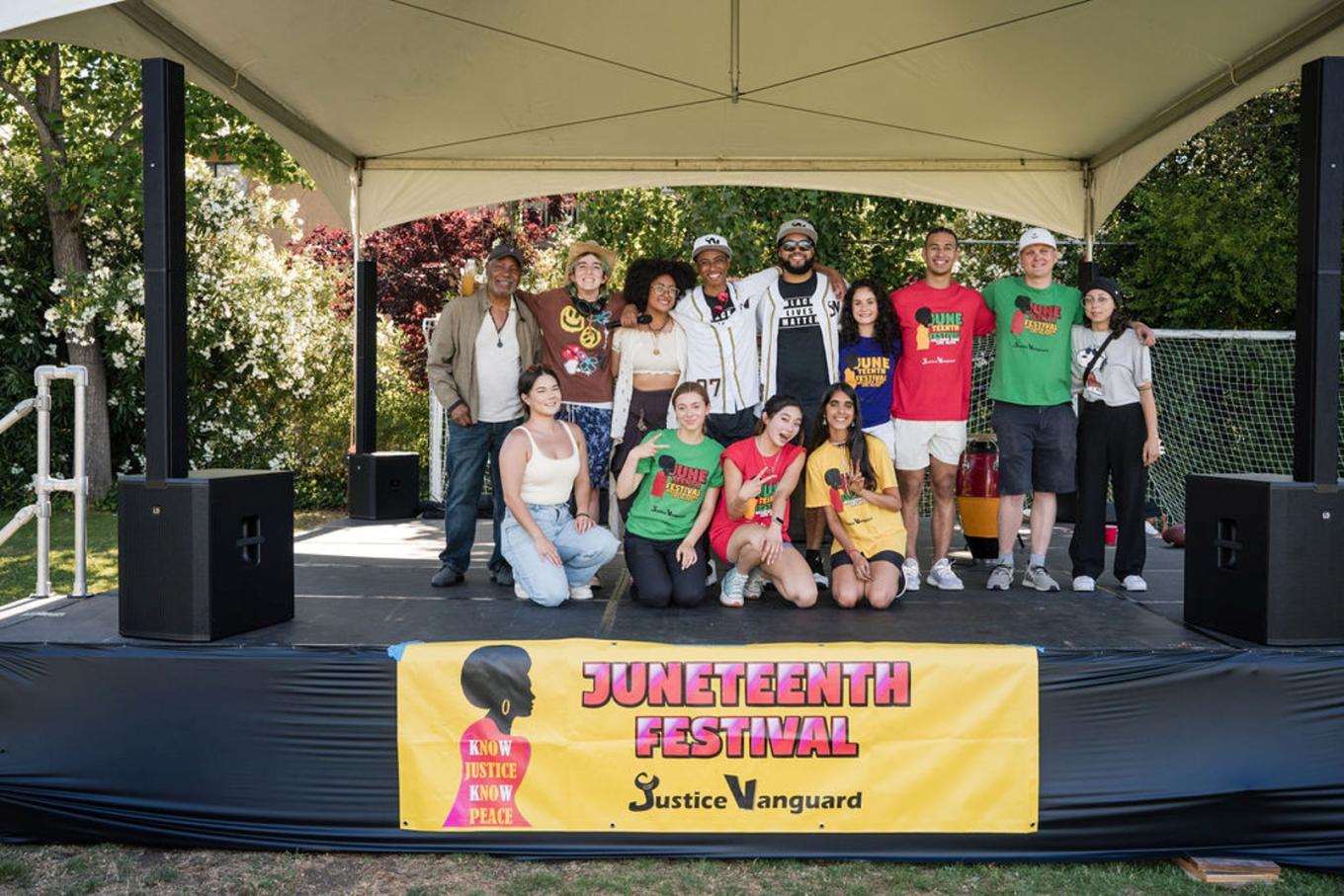
(Photo: Kenan Moos and Kiyoshi Taylor, co-founders of Justice Vanguard, with students at the 2024 Juneteenth Festival)
You have made celebration a core pillar of your model. Beyond attendance numbers, what have you found to be the measurable impact of using joy as a tool to dismantle systemic bias?
Kenan: We call it deceptive education. We do not promote our events by saying "come learn about racism." Most people, honestly, will not show up for that. But if you say, come hear this incredible musician perform the journey of Frederick Douglass through the history of Black music, people come for that. And while they are there, they learn. At our Juneteenth festival, kids learn the history and significance of the celebration through drum circles, trivia, and interactive activities.
One of the most telling measures of impact is how students greet us when we come back to their schools; they run up, give high fives, try to get a hug in. We also hear from parents who realize we're covering things they themselves were never taught, which opens up a whole other conversation at home; that ripple effect matters. This energy tells us the conversations are landing and making real change.

(photo: Crowd at the Juneteenth Festival following a speech from co-founder, Kiyoshi Taylor’s calling for more active and engaged communities)
Your Together Towards Tomorrow win focused on intergenerational leadership. Can you share a moment where youth-led urgency and established community experience led to a better, more durable solution?
Kenan: Everything we do is built on that exchange, but one moment that crystallizes it happened through our print studio. The printer we use was donated by Emory Douglas, the original Black Panther artist and the Minister of Culture for the Black Panther Party. We sat down with him alongside some of our interns, shared the work we were doing, and asked how the Panthers had built community reach across generations. The Black Panther newspaper was a big part of his answer, and that conversation is directly where the idea for our zines came from.
Then we took those same interns to the Women of the Black Panther Party Museum in Oakland. They heard from elders about how the Party was overwhelmingly sustained by women, people who have been largely written out of the popular narrative. The interns came back different. They started seeing themselves inside the history, not just as students of it; that’s what’s driving the work.
That is what intergenerational leadership actually looks like; elders bring history while young people bring urgency and the instinct for what lands now. The point is that you need both, and you need to build real structures for both voices to actually shape the work.
By launching a production studio, you are creating your own media. For other changemakers, what is the value of owning your own narrative infrastructure to tell your story?
Kenan: Most of the time, when communities like ours appear in history books or on the news, it is through someone else's lens. Someone goes into a community that is not theirs, decides what is worth documenting, and frames the story around their own assumptions; what gets left out is often the most important part narrated from the people within the community.
We did a documentary on the 1966 Dayton school desegregation riots, and we went in thinking we would talk about the policy and the process. But every single person we interviewed started talking about a murder that has almost no presence in the official record: a man who had already killed dozens of Black community members in Dayton, and whose murder of the official leading desegregation set off the riots. That was an important story to tell, and without a production studio we control, we wouldn’t have had a platform to tell it.
We started on Zoom during the pandemic, just recording conversations with professors, philosophers, and Black Panthers. Eventually we built our own studio, with green screens and a backdrop to make operations more efficient. The speed matters as these stories are on the brink of being lost.
We started with our own families, Kiyoshi's grandfather, who grew up during the Great Migration, sat down with us and shared his story and I recorded my grandfather's story of escaping the Holocaust. From there, it grew to five documentaries in progress. The through-line is always the same: the most honest, truthful version of a story, told by the people who actually lived it.
Systems change is slow. What approaches have actually moved the needle when educating people about systemic racism and representation, and what remains your hardest challenge?
Kenan: The hardest challenge, without question, is funding. Over the past year and a half, we had grants we were finalists for that were completely defunded. When you are a small team, you can only apply to so many things. Recently, we helped run a youth leadership conference where students led their own workshops on immigration, ICE, and know-your-rights campaigns, all for free. That kind of work only happens when we are not in survival mode.
On what actually moves the needle: it is getting students to become the educators themselves. We publish zines designed and researched by our interns, young people exploring movements, music, food access, environmental justice, and every single one includes a call to action. We want students to leave with enough context that they truly understand the need to act and are inspired to do so. The context piece matters because the school system is not filling it. What most students get is one class on Rosa Parks, Martin Luther King and the unit moves on.
We helped create an ethnic studies curriculum that was being used in several California school districts, covering Indigenous history, AAPI history, Black history and the ways communities have worked together across movements. But many of those classes have since been pulled back.
The need for this work is growing, and so is the enthusiasm of young people to lead it. With the right support, we can continue equipping the next generation with the knowledge, confidence, and tools to create meaningful change in their communities.
---
To learn more about Justice Vanguard, visit justicevanguard.org. To explore Ashoka Changemakers' latest open innovation challenges, visit changemakers.com.
To receive regular insights from Changemakers delivered directly to your inbox, subscribe to our newsletter.