Age
15
Country of Residence
Kenya
Founding Story: What was the spark that led you to start your project? What was the "Aha!" moment that led you to get started and see the potential for this to succeed?
My idea came from a church program in April. We visited children living in the slums of Dandora and Korogocho in Nairobi. We wanted to give them food and things they needed. While I was there, I saw another problem they faced. Many families live near the waters of the Nairobi River and its big streams like the Mathare and Ngong rivers. It made me sad to know that this is the place they live every day. The water was black, no fish;only plastic, diapers and metal waste. A friend who lives in Dandora told me that every Wednesday a group of people work together to collect the floating waste. This is good but does not solve the main problem, which is the waste that is under the water. Also, the microplastics and the oil leaks are not being properly dealt with. The problem is much bigger and deeper than we realize. I realized that most people focus on the waste that's on top but they ignore the waste that is at the bottom. That is why I thought of AQUACLEAN. An underwater remote-controlled drone that goes into the water and collects all the waste that is under the water, takes in microplastics and clears oil present. The project is based on my desire to protect life in the water and help people live in healthier places.
How do you encourage other people to join your project or learn about the problem you’re working on? If you have a new idea, tell us how you will do this in the future.
I will show people my plan, raise awareness of how water pollution hurts the world, and also convince people and organizations to get involved. I will ask them to share their thoughts and use their skills. This will be possible by speaking in the school assembly, attending the science fair, using social media, and involving the local community. I hope to inspire people and be an example by working hard to make AQUACLEAN a reality and make a difference. As a young Kenyan girl, I will show how good things can happen with teamwork and determination.
How many people are on your team?
4
Impact: How has your project created impact / made a difference so far? Or, if at an early stage, what will impact look like?
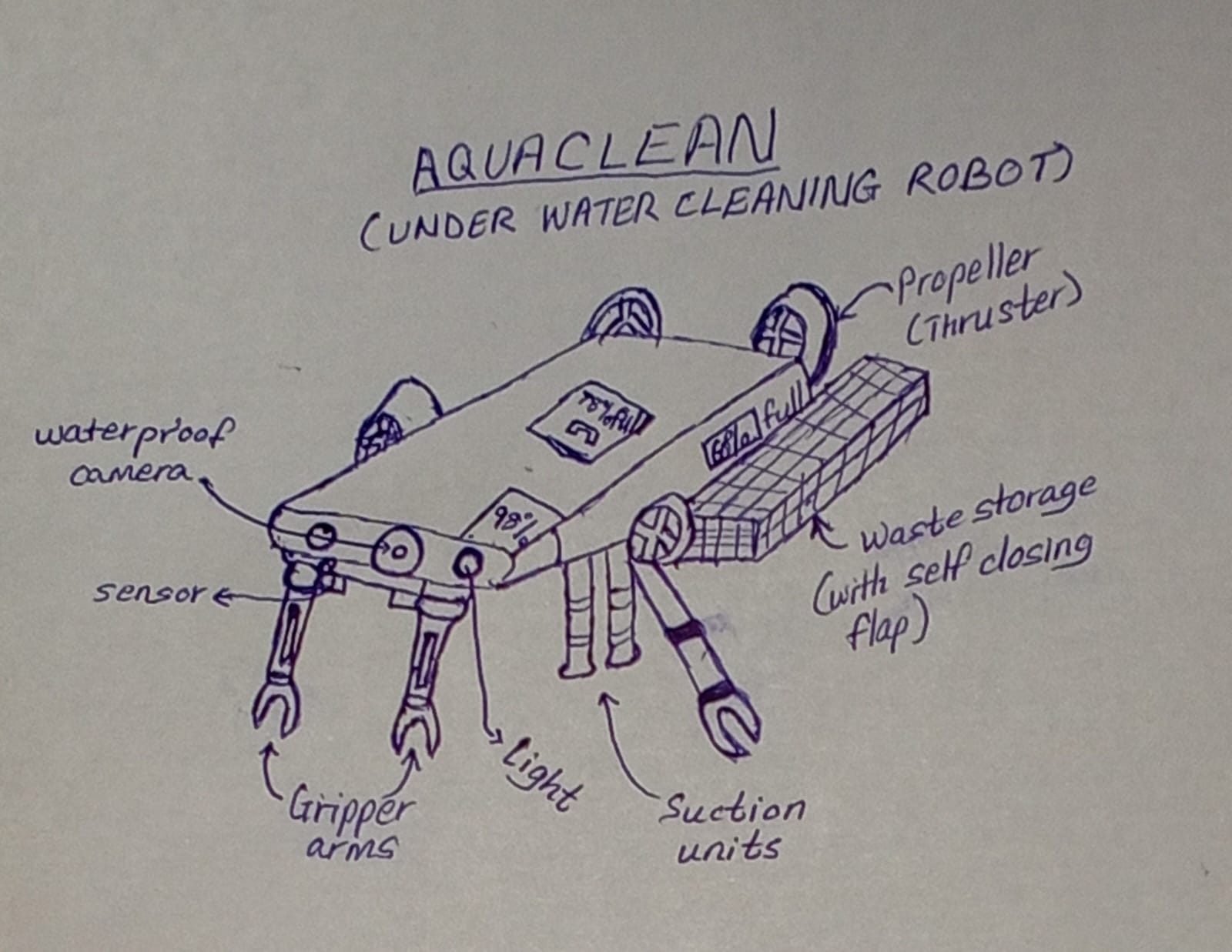
AQUACLEAN is still an idea. It starts with a question: What if we could reach the pollution under the water instead of neglecting it and watching it hurt people and animals? I am working on how the cameras, sensors, arms, suction pumps, and storage system can all work together. The impact may not happen right away, but Aquaclean can be a great addition to the way people clean water bodies. It can focus on the waste under the water. This is why AQUACLEAN will make a difference. I believe cleaning both the top and bottom of the water bodies is our chance to make the water clean again and bring life back to those waters. I plan to build a prototype and test it before using it in deeper waters. And when it works, AQUACLEAN could collect waste that's hard to pick up by hand. It can help protect habitats for animals and partner with recycling companies. I will measure the success by how much waste is collected, how many places are cleaned, and how many people are involved and have benefited. By using Aquaclean, the environment will get better over time; the animals will also benefit, and the water will become cleaner and healthier.
Project Category
My project is a brand new / emerging idea
Project Stage
Idea (We’re hoping to get started in the future)
Project Summary: Describe your project in one sentence
AQUACLEAN is a kind of underwater drone. Its design came from seeing rivers like the Nairobi River and the Athi River. The goal is to find and collect submerged plastics, metals, microplastics and oil spills. This helps to make the water cleaner. As a result, it helps protect animals that live in the water and gives hope to people who live near the polluted water.
Project title
AQUACLEAN
The Problem: What problem are you helping to solve? Why does it matter to you and your community?
In the areas of Dandora and Korogocho where the Nairobi and Mathare Rivers flow, the water is full of pollution, dark in color, and unappealing to look at. The air is not clean because of the fumes from the polluted water. Living like this for a long period can cause serious health problems like cholera, typhoid, and skin infections. The air can also cause breathing problems and respiratory issues. Under the water, there is waste. There is metal, large plastics, microplastics, and oil. These things can harm the animals that live in the water. They can destroy their homes and cause problems for people who need and rely on clean water. The ways we use now to clean the water can't reach the submerged waste. They can't find types of pollution and only look for larger, visible waste on the water surface. We need smarter and gentler ways to find, reach, and remove the pollutants deep in our water bodies.
Website URL(s) or social media handles.
https://www.instagram.com/simply._.millyy?obrf=MTNibGw1NGE3ODhwNQ== https://www.linkedin.com/in/joan-waitherero-205ba03b3?utm_source=share_via&utm_content=profile&utm_medium=member_android https://x.com/miamourscience
What’s Next: What are the next steps you plan to take to grow or strengthen your project over the next year? If your project is still in the idea stage, describe the steps you will take over the next three months to launch or begin developing it.
I want to make AQUACLEAN a working, innovative machine. Step 1: Learn and plan. I will study robots and machines, buoyancy, water pressure, sensors, and remote control. I will make my design better and find the best parts for my needs. I will talk to teachers, engineers, and experts to make sure my idea works. Step 2: Design and build a model. I will make a model of AQUACLEAN. I will show the gripper arms, the suction parts, the waterproof cameras, the sensors, and the storage with the one-way flap. I will use parts that aren't too expensive using the grant money and find people to guide me in making the first prototype. Step 3: Build and test. I will make a model and check how it works. I will see how it moves, how well it collects waste, and how the storage system works. I will document what I learn, what needs to be better, and improve the design. After three months, I hope to work with my school, environmental groups, recycling companies, and engineers. These people can help me get the help and tools to test AQUACLEAN in actual water bodies.
Your Innovation: What is different about your project compared to other programs or solutions already out there? How is your project new or innovative?
Unlike current ways of cleaning polluted water, which only focus on the waste on the surface, AQUACLEAN is designed to go deep into the water and collect the waste that is hidden. Its main advantage is that it integrates different functions into a single underwater drone rather than relying on single-purpose machines. It has four arms with grippers to pick up waste like bottles, bags, diapers, and metal. It has two suction systems for microplastics and oil accumulation in the water. It has an indicator that alerts the operator when full. Then the drone returns to a designated place to unload. In partnership with recycling companies, the waste will be reused and recycled for better purposes in society. Also, some of the waste will be used to make better designs of the AQUACLEN model rather than buying everything.
Your Solution: How are you solving this problem? Share your specific solution.
AQUACLEAN is designed to reach waste that's difficult or dangerous to pick up by hand. An operator will use a computer to control the drone while out of the polluted water. This keeps people away from the polluted water but still preserves people’s jobs. Waterproof cameras will help the operator see under the water. Sensors will help detect the pollutants in the water. Four arms with grippers will pick up items like plastic bottles, bags, and diapers. The waste is kept in a meshed storage container that allows water to pass through, but the waste stays inside. This storage container is attached to the side of the drone. The opening has a one-way, spring-loaded flap that closes after the waste goes in; this keeps the waste from escaping as the drone moves and while waste collection is still in process. The box also has suction pumps. The pumps take in microplastics and oil. The pumps send the waste to its built-in storage tank. A capacitor indicator will alert the operator when the container and tank are full. The drone then goes back to a designated area to unload. Then, the waste is taken to recycling centers. AQUACLEAN is designed to make the water cleaner, protect animals, and make life safer for people. I am working on the design. Plan to build a model and test it. I believe technology should not just make life easier; it should also help us fix the damage we caused and create a better place for ourselves and future generations.
Your team: What role(s) do your team members play? How do you share leadership with them?
I am working with my mentors, Mr. Wilson Kinyua and Mr. Amos Kipchumba. Also, my older brother who is an electrical engineer. In the future, I hope to bring in drone engineers, software engineers, mechanical engineers, marine specialists, environmentalists, and a lawyer. I value collaboration and believe that teamwork makes the dream work.