Age
12
Country of Residence
United States
Founding Story: What was the spark that led you to start your project? What was the "Aha!" moment that led you to get started and see the potential for this to succeed?
About 6,000 doughnuts a day. That was a worker’s estimate of how many a Grapevine doughnut shop threw away. My questions had started in my lunchbox: I wanted to finish food I brought home, while my mom worried it had been sitting out too long. How do we decide what to keep? Hearing that estimate made the problem feel much bigger than our kitchen. In October 2025, I began building a sensor to investigate changes around food. I tested containers, recorded readings, and revised the hardware. Then I visited GRACE Grapevine, Community Storehouse, and 6 Stones. I thought they would need my device. Instead, I learned they already had ways to assess donations. Families needed clearer help understanding package dates. That was my turning point: I could use what I was learning to make something useful now. GRACE shared donation guidance, and I created the Label Decoder. Watching seniors read it at Hurst led me to redesign it. Later, organizations began sharing it in their own outreach. I had spent months on the sensor, but listening changed what I made next. I want other students to experience that too: notice a problem, investigate it, and work with their community to make a difference.
How do you encourage other people to join your project or learn about the problem you’re working on? If you have a new idea, tell us how you will do this in the future.
I go to places people already use and ask how EcoServe could help. A demonstration invites questions about food science; a free decoder gives families something to take home. People can participate without buying a sensor or using a smartphone. My estimated outreach is about 450 people, with more than 200 decoders distributed; those measures overlap. I invite staff to review the guide and explain what donors ask. GRACE shared guidance that changed my direction, and 6 Stones reviewed and displayed the decoder. Watching seniors read it at Hurst prompted a redesign. Listening gives people a real role in improving the work. Others now carry it forward: CCD placed additional copies around its center and presented it at a community event; Bedford’s senior care center shared copies for seniors’ homes. Their involvement reaches people beyond my own presentations. Next, I plan to invite two student co-leaders and ask a host to help shape a short activity. Participants will bring confusing labels, practice examples, and choose an action that fits their lives. Students will help facilitate and collect feedback. I will share what we learn with the host and participants, including what changed because of their ideas.
How many people are on your team?
1
Impact: How has your project created impact / made a difference so far? Or, if at an early stage, what will impact look like?
I have distributed more than 200 free Label Decoders and estimate my outreach has reached about 450 people; these measures overlap. Earlier records list eight placements across libraries, senior centers, and 6 Stones. At 6 Stones, staff reviewed the guide and displayed it in the family pickup area. The clearest progress is organizations using it in their own outreach. Catholic Charities Dallas said its existing flyer was less comprehensive and lacked key information for different food categories. Staff replaced it with my decoder, placed more copies around the center, and presented it at a community event to encourage donations. They felt it could help increase donations. The senior care center in Bedford had no decoder for its food-donation area. Staff shared copies for seniors’ homes, explaining that some foods may remain eligible for donation after a quality date, subject to food-specific guidance and donation rules. Staff reported increased donations, although I do not yet have counts or a comparison period. These are encouraging signs of adoption and an early reported outcome, rather than a measured causal effect. My next step is to document donation trends and household food waste so I can understand the size and persistence of the benefits.
Project Category
My project is an existing project that I started
Project Stage
Growth (We’ve moved past the very first activities and are beginning to have consistent weekly or monthly impact)
Project Summary: Describe your project in one sentence
I use food-science demonstrations and free Label Decoders to help families waste less food and help community organizations encourage informed donations.
Project title
EcoServe: Reducing Food Waste and Encouraging Donations Through Food Science and Education
The Problem: What problem are you helping to solve? Why does it matter to you and your community?
Uncertainty about food dates can lead people to throw food away or decide not to donate it. Families need clear explanations that also account for food type, storage, handling, and the receiving organization’s requirements. My pantry visits revealed a practical gap: staff had ways to assess donations, but donors needed understandable information. Catholic Charities Dallas told me its existing flyer lacked key details for different food categories. The senior care center in Bedford told me it had no label decoder for its food-donation area. These conversations showed me where my work could help. Food waste matters to me because food takes money, water, energy, and people’s work to produce. Volunteering at Community Storehouse helped me appreciate the effort involved in getting food to families. I wanted to connect my interest in science to that community need. I focus on families and potential donors reached through DFW libraries, senior centers, and food-assistance organizations. A child can bring a guide home; a senior can use it when considering a donation; staff can share it with someone who has a question. My goal is to help people use food in time, understand what may be donated, and turn that learning into everyday action.
Website URL(s) or social media handles.
https://ecoserve.online/
What’s Next: What are the next steps you plan to take to grow or strengthen your project over the next year? If your project is still in the idea stage, describe the steps you will take over the next three months to launch or begin developing it.
In the first three months, I will ask CCD and Bedford’s senior care center to document how they use the decoder. With a willing host, I want to compare donation records across similar periods, tracking accepted amounts, food categories, and other campaigns that could affect results. I will seek qualified review of the guide and recruit two students to help create a short activity. Our first milestone will be a session a teammate helps plan and leads, followed by revisions from participant feedback and reusable materials for the host. Next, with host support, I plan a six-week pilot with 20 households: two weeks recording avoidable food discards, then four weeks trying a chosen habit. We will compare weekly discarded weight and purchase value and follow up on whether habits last. Donation results will be reported separately. If useful to participants and hosts, I aim to expand toward 100 households across three sites and train up to five youth facilitators, including me, by year-end. These are goals, not existing commitments. I will report actual results, including no improvement. I will continue controlled sensor trials and seek a scientific mentor. Challenge support would help provide printing, shared measuring equipment, and teaching materials so communities can run, improve, and measure the program themselves.
Your Innovation: What is different about your project compared to other programs or solutions already out there? How is your project new or innovative?
EcoServe connects student-led food science with a practical resource shaped by the people using it. I test ideas in two places: at my workbench and in my community. At the workbench, a sensor once gave similar readings for fresh and spoiled food for four weeks. I investigated the parts and power supply and redesigned the circuit. Comparing airtight and leaky containers made me examine humidity and test conditions more carefully. I document failures as well as useful observations so other students can learn how I reached a conclusion. In the community, pantry conversations changed my focus from a device to clearer food-label explanations. Watching seniors read the decoder at Hurst led me to redesign it. Catholic Charities Dallas identified a specific advantage over its existing flyer: my decoder brought together important information for different food categories. Bedford’s senior care center could use it where no decoder was available. Date-label education already exists. My contribution is connecting it to hands-on investigation, adapting it for different readers, and getting it into places where people make donation decisions. The science draws people into a conversation; the guide gives them something useful to take home or share. Their questions guide what I explain or test next. I am also developing a simpler DIY build guide so students can try the engineering. I want them to practice both testing an idea and listening to people, then adapt what they learn to their own community.
Your Solution: How are you solving this problem? Share your specific solution.
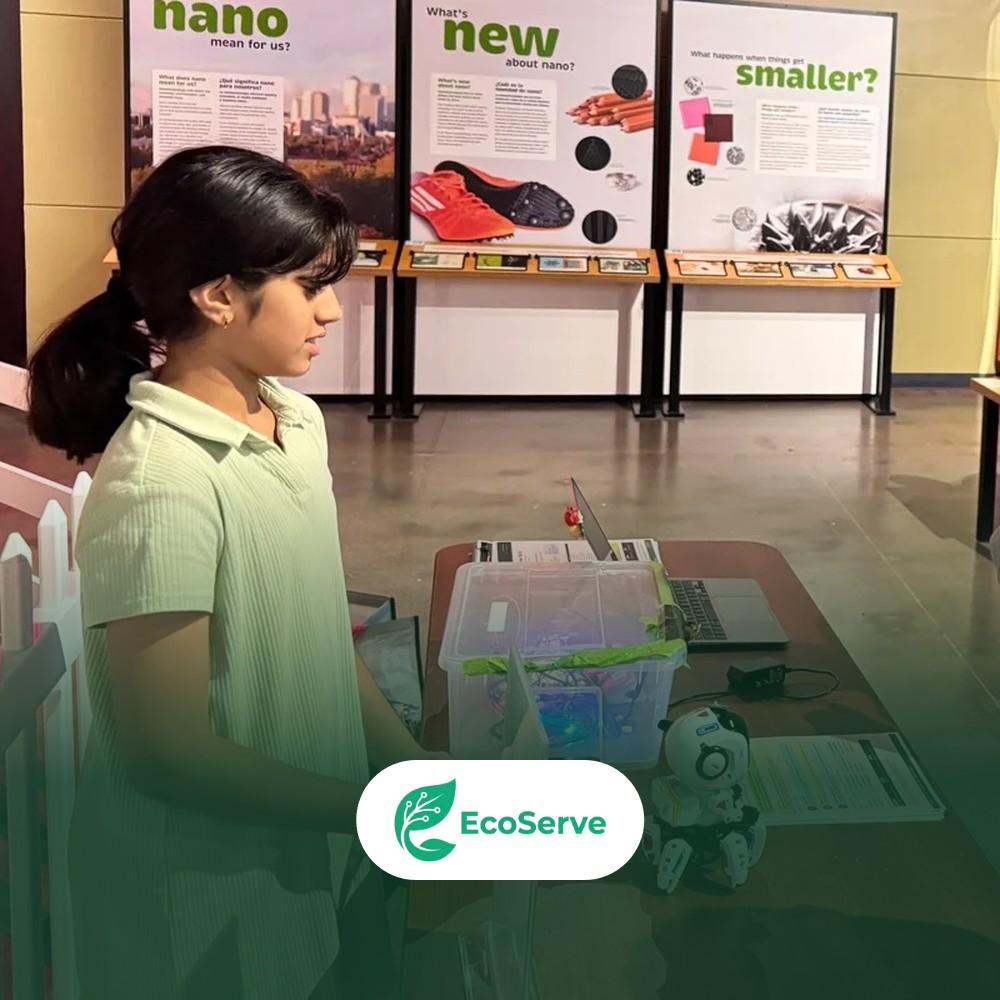
EcoServe combines hands-on food science with a free resource families and community organizations can use. I build sensor prototypes to investigate changes around food and share experiments in a public notebook. I have tested container seals, investigated gas readings and humidity, and worked through power problems. At demonstrations, the equipment makes people curious and gives me a way to explain what I am testing. The prototype is a research and teaching tool, not a food-safety test. The Label Decoder brings date-label explanations and information for different food categories together on one page, with versions for children and adults. People can download or print it without buying a sensor. Pantry feedback helped shape it, and watching seniors read it helped me improve its design. It supports informed decisions alongside storage and handling guidance and each organization’s donation rules. I share the resource through presentations, demonstrations, libraries, senior centers, and food-assistance organizations. Catholic Charities Dallas has used it in its own donation outreach, and Bedford’s senior care center has shared copies for use in seniors’ homes. This lets the work continue beyond events I attend. Next, I want to create a short activity and facilitator guide another student or staff member can use. Participants will bring questions, practice interpreting examples, and choose a food-saving or donation-related action that fits their situation. Follow-up will help us learn what they actually did. I will keep improving the sensor while measuring whether the educational work helps people waste less and donate more confidently.
Your team: What role(s) do your team members play? How do you share leadership with them?
I am the founder and only student team member. I lead experiments, documentation, materials, outreach, and presentations. My mom helps with logistics; my Davidson Ambassador advisor supports me. Community hosts review and share the guide, and their feedback changes my work. I plan to recruit two student co-leaders: one to help design and lead activities, another to organize questions and follow-up. We will revise materials together and rotate facilitation.
