Age
16
Country of Residence
Nigeria
Founding Story: What was the spark that led you to start your project? What was the "Aha!" moment that led you to get started and see the potential for this to succeed?
For a long time, I knew I wanted to build something meaningful, but I didn’t know what that would be eventually but i was sure it wasn’t a lack of ideas. My challenge was knowing how to turn what I had into something real. What I did have was a genuine connection with children and a deep passion for the environment and sustainability. And again for a long while, I never saw how useful those two things could be together. My “aha” moment came when I finally found the link between them. Once it clicked, everything started to move. I realized I could combine augmented reality with artificial intelligence to make environmental learning something children could see, explore, and enjoy. That idea became GreenLens. I started building right away, because for the first time the path was clear. Two things I cared about had become one purpose. That is why I believe GreenLens can succeed: it comes from something I genuinely care about, and it meets children where they are, using technology to make learning about our planet exciting.
How do you encourage other people to join your project or learn about the problem you’re working on? If you have a new idea, tell us how you will do this in the future.
We encourage people to learn about sustainability by asking them to take it one step at a time. Instead of overwhelming anyone with everything they should change, we introduce gradual habits, like reducing single-use plastics or composting kitchen scraps. Small steps feel doable, and doable things are more likely to last. GreenLens makes these steps easy to follow. Children see lessons come alive through AR animations and AI-generated videos with characters like Ada, Mateo and Mei. Parents are included so families can practise the habits together at home. Going forward, We plan to introduce simple weekly challenges, like a plastic-free day, where children and parents can track their progress and celebrate small wins. We also hope to start school eco clubs where children become young ambassadors and teach their peers, and to share their stories on our social media so more people feel invited to join. Our belief is simple: when people learn in small steps and are supported to keep going, better habits become normal.
How many people are on your team?
3
Impact: How has your project created impact / made a difference so far? Or, if at an early stage, what will impact look like?
GreenLens is still in its early stage. The AI video content is always a continuous work where by the animation team keeps building on every new production, and the AR tool that animates static images is built. So far, my focus has been on creating something children will want to engage with. I've tried GreenLens with over 30 children, an investor and some parents who supports the solution and sees it as an opportunity for their children to not just learn but also practice what they've learnt. The impact I hope to make is a shift from awareness to action. I want children in my community to understand how plastic pollution and poor waste management affects their environment, and also I want them to carry that into their daily habits, like how they dispose of waste at home and in their neighborhoods. I believe it will work because it deals with what I’ve seen outreach lack: consistency. Children already spend time on videos and visuals, so GreenLens meets them there. Instead of one-time lessons, they get characters like Ada, Mateo, and Mei and AR animations they can always come back to. When learning is something children enjoy, it is far more likely to stick. In the long run, I want to see a community where better habits are normal, and where the next generation doesn’t grow up seeing littering as a way of life like I did.
Project Category
My project is an existing project that I started
Project Stage
Pilot-Stage (We’ve tried an activity or two)
Project Summary: Describe your project in one sentence
GreenLens is an Augumented Reality project that makes learning about sustainability fun and engaging for children. It combines my custom physical storybooks with augmented reality to bring stories to life, helping children understand environmental issues such as pollution, flooding, and climate change. Through interactive visual experiences, GreenLens makes learning more relatable and encourages children to develop sustainable habits.
Project title
GreenLens
The Problem: What problem are you helping to solve? Why does it matter to you and your community?
Lack of Environmental awareness is a problem I want to solve in my community, and it have become really alarming lately. I grew up in an environment where trash was littered almost everywhere. It was so common that it stopped feeling like a problem and became a way of life. When floods come, many of us blame the government saying things like they're not good leaders, they always have false memorandom and the likes of it. Overtime, it dawned on me that we had forgotten that our own small, everyday actions like how we dispose of waste, plays a very vital part in what happens to us and then the consequences land on our own doorsteps. That’s when I realized the issue isn’t only about infrastructure or policy. It’s about awareness. People can’t change habits they don’t know are harmful and I truly believe that if our people know better, they will do better. This matters so much to me because this is my home. I’ve lived with these conditions for years and seen what they cost us. That’s why I focus on children because they can grow up with better habits and carry them into their homes and neighborhoods, so the next generation doesn’t inherit the same “normal” I did.
Website URL(s) or social media handles.
Youtube - @LittleEarthHeroes-j5j AND Instagram - littleearth.heroes
What’s Next: What are the next steps you plan to take to grow or strengthen your project over the next year? If your project is still in the idea stage, describe the steps you will take over the next three months to launch or begin developing it.
First, I plan to pilot GreenLens with a group of children in my community, at some schools, most especially the school I attended and also with parents as well. This will show me how they respond to the AR animations and the AI videos, and what keeps them coming back. Second, I want to collect feedback from the children their parents, and teachers, then I can use it to improve the content. Since parents are part of the audience, I’ll look for ways to help them support their children in practicing simple habits at home, like proper waste disposal. Third, I want to address what outreach lacks: consistency. I plan to build in ways for children to keep engaging over time, such as new characters, new lessons, and new topics beyond plastic pollution and waste management. Finally, I hope to partner with schools and community organizations so GreenLens can reach more children than I could alone. With these steps, I want to track real results, such as how many children it reaches and what changes in their habits, so I can show that it works and grow from there.
Your Innovation: What is different about your project compared to other programs or solutions already out there? How is your project new or innovative?
Most environmental awareness programs I’ve seen rely on outreach and the media as well. It's mostly about talks, workshops, and campaigns where people are taught better habits. They matter, but they usually happen once, and they rely on people remembering and acting on what they heard. From my own experience, that is where they fall short. There is little accountability or consistency after the event ends. GreenLens takes a different route by applying existing technology in a new context. It combines Augmented Reality and Artificial Intelligence to make sustainability learning something children can see, explore, and enjoy. Using AR, static images come to life through animation, so a picture of plastic waste becomes a lesson children can watch unfold rather than just read about. Alongside this, AI-generated videos follow characters like Ada, Mateo, and Mei as they learn about plastic pollution and waste management. What makes this different is where it meets people. Instead of asking children to come to a program, GreenLens goes to the kind of content they already spend their time on. It turns learning into something they want to return to, not a single event they forget. It’s also built with the whole family in mind. Children are the main audience because I personally believe that children should not be neglected of learning about climate change, but parents are included because they need the knowledge to help their children practice simple, actionable steps at home. I’m applying AR and AI to a challenge in my community that is usually approached the same way every time, with the goal of sustainability literacy where people take action instead of just knowing better.
Your Solution: How are you solving this problem? Share your specific solution.
The problem I’m solving is the lack of environmental awareness in my community, but for me, I’m approaching it differently from most people. I got to realize that most efforts rely on outreach where people gather, someone teaches better habits, and everyone goes home. So, I don’t think outreach is bad, instead I believe it's a very good idea but then again, I wonder whether it lasts and that's because I’m an example myself. I’ve been taught things I never acted on, not because I didn't want to, but because nothing kept me accountable or consistent. I believe the same thing is happening to 99 others. So I decided to solve it through media, something people already spend their time with. GreenLens which is my solution, combines Augmented Reality and Artificial Intelligence to make learning about sustainability fun, easy, and engaging for kids most especially. Here’s how it works. GreenLens uses AR to animate static images, so children see environmental lessons come to life instead of just hearing about them. Alongside it, AI-generated videos follow characters like Ada, Mateo, and Mei as they explore plastic pollution, waste management and other sustainable topics or practices. The aim is for children to want to come back to it, so that learning becomes a habit instead of a one-time event that might be forgotten. That tackles the consistency gap that most outreach leaves behind. Parents are part of the picture too. They need the knowledge to help their children practice simple and actionable steps at home. The goal is sustainability literacy, where people don’t only know better but actually do better.
Your team: What role(s) do your team members play? How do you share leadership with them?
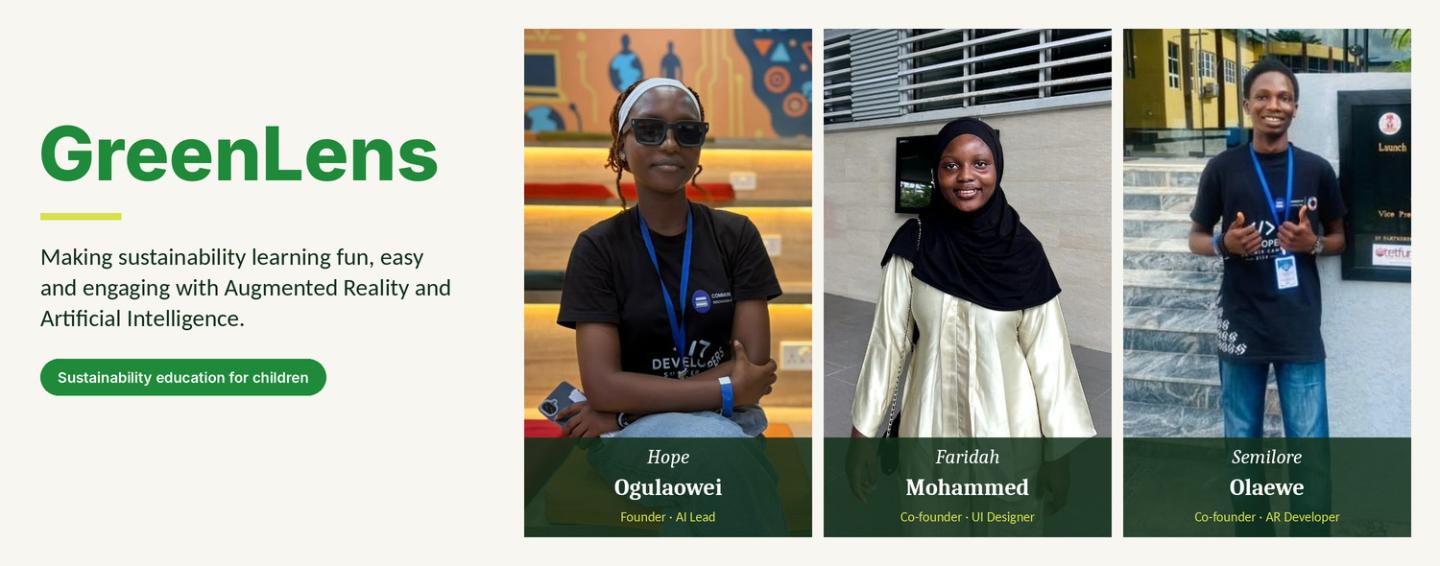
GreenLens is built by a team of three. I’m the Founder and AI lead, and I also manage our social media content making sure to create videos that are very fun and engaging for kids. Faridah Mohammed is our UI designer, shaping how GreenLens looks and feels for children. Semilore is our AR developer, building the augmented reality experience that brings our images to life. My team always review our work together before anything goes out, so that every decision always reflects all three of us.
