Country of Residence
United States
Age
16
Project title
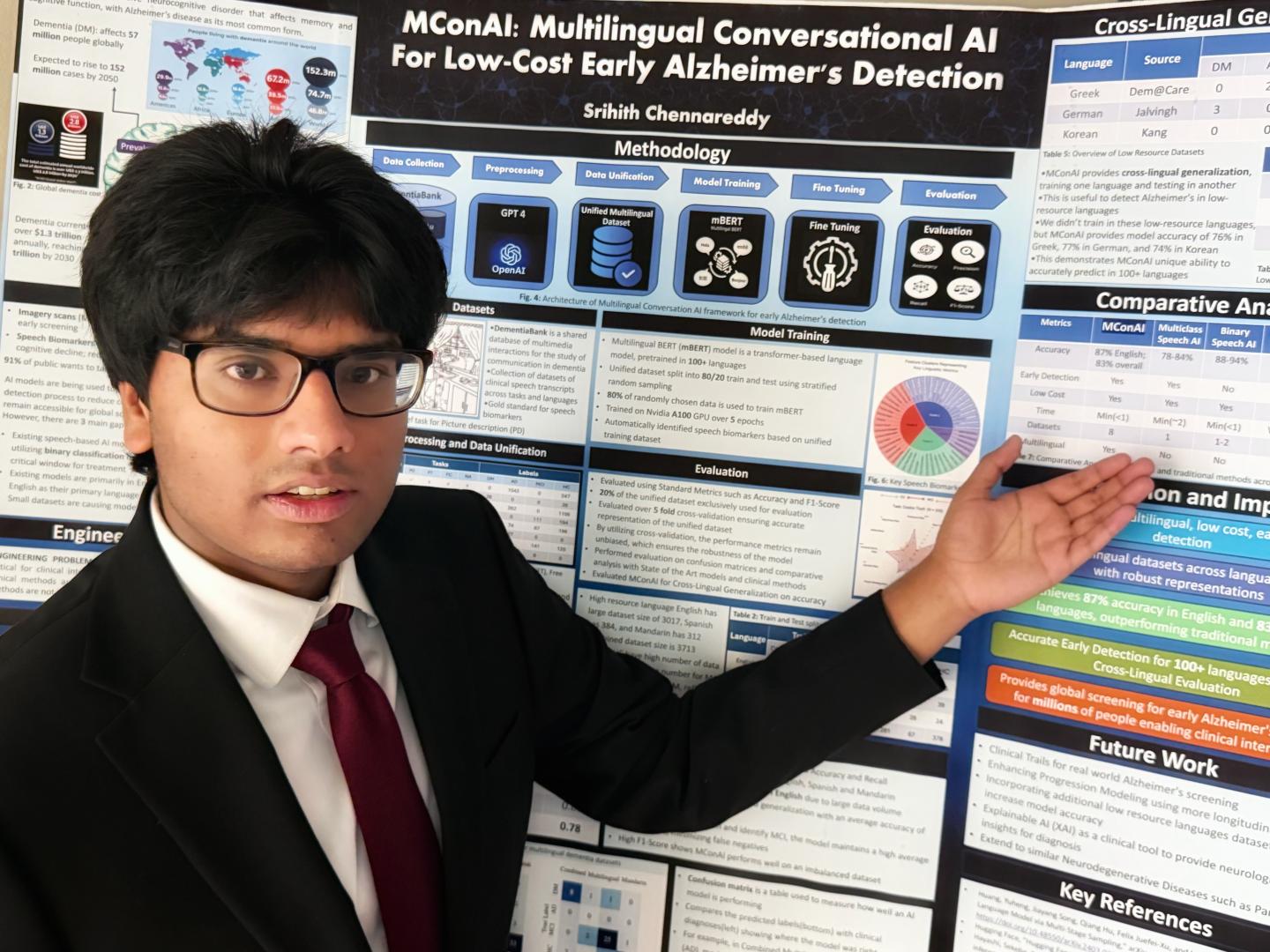
MConAI: Multilingual Conversational AI for Low-Cost Early Alzheimer's Detection
Project Summary: Describe your project in one sentence
MConAI is an affordable multilingual conversational AI system for early Alzheimer’s screening across English, Spanish, and Mandarin that combines DementiaBank datasets and uses mBERT model, to detect subtle cognitive-linguistic biomarkers, enabling scalable and low-cost early detection of Alzheimer’s that has the potential to benefit millions of people worldwide, especially in low-resource regions.
Website URL(s) or social media handles.
https://www.linkedin.com/in/srihithchennareddy/
Project Category
My project is a brand new / emerging idea
Project Stage
Scaling (We’re expanding impact to new locations or in new and innovative ways)
Founding Story: What was the spark that led you to start your project? What was the "Aha!" moment that led you to get started and see the potential for this to succeed?
Motivated by my grandfather's experience, I began developing MConAI, which analyzes subtle cognitive-linguistic biomarkers for early Alzheimer's detection. Growing up, I spent my summers at my grandfather’s farmhouse overlooking fields of wheat and pastures dotted with grazing goats. In the evenings, we followed a narrow trail to a weathered bench above the canyon. As the sun dipped below the horizon, I listened to his stories. He often recited the same ones over and over. Then one summer, as we sat overlooking the river, just a few seconds into his familiar tale, he started mumbling. He stared across the canyon as if searching for a detail that he remembered dozens of times. The silence stretched on. I waited for him to laugh and continue. He didn't. Soon after, he was diagnosed with Alzheimer's. I began learning about how Alzheimer's is detected in later stages, as cognitive changes are subtle. I thought back to my grandfather's shaky speech, and wondered if speech could be used to detect Alzheimer's. I began conducting research at USC Keck School of Medicine, Alzheimer's Therapeutic Research Institute and developed MConAI to advance scalable and accessible early Alzheimer's detection.
The Problem: What problem are you helping to solve? Why does it matter to you and your community?
Dementia affects over 50 million people worldwide, and this number is expected to reach 150 million by 2030. Alzheimer’s disease, the most common form of dementia, progressively damages memory and thinking abilities. My experience changed the way I understood Alzheimer’s. Behind these millions with Alzheimer's disease are millions of families having their own version of the experience. Alzheimer’s is often not detected until it reaches more severe stages because cognitive changes can happen gradually. Families may spend a long time trying to understand what they are seeing before they have an explanation. Early detection would provide families time to move from uncertainty and confusion to taking action. Early detection can significantly slow cognitive decline and improve quality of life, yet traditional diagnostic methods such as MRI and PET scans are expensive and inaccessible for large-scale screening, especially in low-resource communities. Additionally, most existing AI-based dementia screening tools only support English, even though nearly 60% of dementia patients are non-English speakers. To expand access to low cost speech based methods, I began developing MConAI using clinical speech.
Your Solution: How are you solving this problem? Share your specific solution.
MConAI offers a low-cost, non-invasive alternative to traditional diagnostic methods such as MRI and PET scans, making early Alzheimer’s detection more accessible, especially in underserved regions. The framework’s multilingual design combines GPT-4–based preprocessing with mBERT-derived semantic and syntactic embeddings, allowing it to identify subtle cognitive-linguistic biomarkers across multiple languages and addressing a critical gap in existing single-language, binary-classification research. I created a unified multilingual conversational dataset by preprocessing various language datasets from DementiaBank using OpenAI’s GPT-4 and trained multilingual BERT (mBERT) on the unified dataset with an 80–20% train-test split using stratified random sampling. MConAI achieved 87% accuracy in English and an average accuracy of 83% across languages. It also provides strong cross-language generalization based on experimental results and model evaluation. Additionally, it demonstrates strong multiclass performance and shows both scalability and real-world applicability. Overall, the work stands out for its clinical relevance, technical novelty, and global impact potential.
Impact: How has your project created impact / made a difference so far? Or, if at an early stage, what will impact look like?
MConAI has the potential to enable early Alzheimer’s detection worldwide, helping millions of people access timely care and support including my grandfather, particularly in low-resource communities. Speech is a low-cost alternative that preserves cognitive changes. Currently, MConAI achieved 87% accuracy in English and an average accuracy of 83% across languages, across multiple independent Dementia Bank Datasets. My work for MConAI has won the Gloria Barron Prize for Young Heroes National Grand Winner (1 of 15) and was selected as a Youth Service America Everyday Young Hero. MConAI has been published and presented at the ACM International Artificial Intelligence and Cloud Computing Conference. I also presented the research at the Alzheimer’s Association International Conference (AAIC) Neuroscience Next. Beyond MConAI, I began speaking and writing to expand Alzheimer's awareness, especially the importance of early detection. Through this, I hoped that sharing my own experience with the disease could help others dealing with Alzheimer's. I have written articles in The Seattle Times, while hosting and speaking at workshops. These have reached over 50,000 people.
Your Innovation: What is different about your project compared to other programs or solutions already out there? How is your project new or innovative?
Traditional clinical methods for detecting Alzheimer’s disease, such as MRI, PET imaging, and cerebrospinal fluid analysis, are expensive, time-consuming, and not practical for large-scale early screening. Speech-based methods show great potential for early detection of Alzheimer’s, as a key biomarker of cognitive decline. However, most existing solutions rely on single-language datasets, primarily in English, which limits cross-linguistic generalization and reduces their applicability in multilingual or culturally diverse settings. MConAI, a multilingual conversational AI framework for low-cost early Alzheimer’s detection by leveraging conversational datasets across diverse languages. The framework uses a multilingual language model, mBERT, which extracts multilingual semantic embeddings to identify cognitive-linguistic biomarkers. Model outputs are categorized into Dementia (DM), Alzheimer’s Disease (AD), Mild Cognitive Impairment (MCI), and Healthy Control (HC). Most of the existing solutions that rely heavily on single-language datasets or binary classification, MConAI supports multiple tasks across diverse languages, multi-class classification, and evaluates cross-lingual transfer performance. By integrating GPT-4 preprocessing with mBERT-based feature extraction, MConAI offers a scalable, accessible, and cost-effective alternative to conventional clinical methods, while maintaining high diagnostic accuracy. The key features of this project include: (1) the development of MConAI, a multilingual AI framework for early Alzheimer’s detection (2) creation of a unified multilingual dataset spanning English, Spanish, and Mandarin from DementiaBank Data Corpus; and (3) a comprehensive cross-lingual evaluation across multiple high-resource languages.
How many people are on your team?
1
Your team: What role(s) do your team members play? How do you share leadership with them?
I worked on this project along with my mentor Dr. Charisse Winston, Keck School of Medicine of USC, Alzheimer’s Therapeutic Research Institute, helped to get access to DementiaBank datasets and provided guidance and support for this project. Next steps for the project include, building our own dementia Bank corpus on low resource speech, working directly with people with Alzheimer's. This would help expand current speech datasets, while testing MConAI’s performance in real world scenarios
What’s Next: What are the next steps you plan to take to grow or strengthen your project over the next year? If your project is still in the idea stage, describe the steps you will take over the next three months to launch or begin developing it.
Further work for MConAI includes expanding to longitudinal datasets for early Alzheimer's detection and incorporating additional low resource languages. My future work will also focus on integrating speech recordings with speech transcripts and incorporating additional datasets to test whether those changes help the model identify cognitive impairment earlier. Further, developing multimodal models, allows additional context to improve accuracy and performance of Alzheimer's detection. Next steps for the project also include collecting speech dataset for low resource languages through Dementia Bank by working with people with Alzheimer's Disease. This would help expand current speech datasets, while testing MConAI’s performance in real world scenarios.
How do you encourage other people to join your project or learn about the problem you’re working on? If you have a new idea, tell us how you will do this in the future.
I am the President and Founder Bellevue High School’s AI Club, where students work on programming, machine learning, and responsible AI use. Students can join MConAI, developing longitudinal Alzheimer' s prediction and identifying novel speech biomarkers. Beyond MConAI, I began speaking and writing to expand Alzheimer's awareness, especially about the importance of early detection. I have written articles in The Seattle Times and hosted and spoken at workshops. In “How Alzheimer’s Changed the Way I Think About AI in Health Care,” I wrote about the uncertainty my family felt as my grandfather’s memory changed. Families in Bellevue and around the world face that same uncertainty. I wanted readers to understand what an earlier diagnosis could give a family. Time to ask questions. Time to discuss care and make plans. Time to make decisions while the person at the center of those decisions can still be meaningfully involved.
