My initiative is designed for and delivered in London
Yes
I am 18 years of age or above, by the application deadline.
Yes
My organisation is a registered UK entity and has a London-based address.
Yes
My organisation is a non-profit (e.g. school, university, or local authority) — not a for-profit, which can only join as a partner.
Yes
If there is a for-profit organisation as a partner in my initiative, they work on a cost-recovery basis only.
Yes
My solution is implemented at scale, or if not, I have a clear business plan, a minimum viable solution (prototype, pilot, or proof of concept), and evidence of work or impact in London within your coalition.
Yes
I am aware that, if I am submitting more than one application to a Challenge run by Ashoka and Go! London, only one of them is able to progress through the stages.
Yes
Are you an employee (and their children and grandchildren) of Ashoka or any of its respective affiliates and participating advertising and promotion agencies?
No
I have read and accepted the Challenge Terms & Conditions
1
First Name
Last Name
Pronouns
Email address
I would like to receive notifications and updates about Go London!, Ashoka, Ashoka Changemakers, and other Ashoka opportunities.
Are you an Ashoka Fellow?
Are you applying from an organization founded by an Ashoka Fellow?
If you are applying from an organization founded by an Ashoka Fellow, please specify the name and organisation of the fellow below.
Initiative Title
Movement for Change: Youth-Led Climate Action Through Physical Activity and Volunteering
Lead Organization Name
The Good Gym
My initiative is designed for and delivered in London
1
Year that you started/ registered your organisation
2009
Website URL(s) or Social Media Handles
www.goodgym.org, www.instagram.com/goodgym, www.facebook.com/gooodgym, www.linkedin.com/company/goodgym
Initiative Stage
Established (You’ve successfully passed early phases and have a plan for the future. Your venture has been in existence for 6 years and above)
Sectors/Themes: What topic does your project most directly relate to?
Environment & Sustainability
Initiative Summary: Describe your initiative in one sentence
Movement for Change mobilises young Londoners (18-25) to take sustained climate action by combining their workouts - running, walking and cycling - with environmental volunteering, supporting activities that restore green and blue spaces and support biodiversity.
Challenge Focus: What topic does your initiative most directly relate to?
Climate action through awareness and engagement
The Problem: What problem are you helping to solve and who will benefit the most from your solution? How close are you to the problem and/or community impacted?
The problem we are helping to solve is the lack of accessible, flexible and locally rooted opportunities for young adults to take part in environmental action through sport and physical activity Across London, environmental opportunities that are youth-led and embedded in everyday life are lacking. Research from the Institute of Health Equity highlights that young people, particularly in urban and lower-income areas, are often excluded from decision-making around climate and environmental justice, despite being disproportionately affected by environmental harms. Access to nature is also unequal. The Woodland Trust reports that many young people experience high levels of climate anxiety while lacking regular access to quality green space, and national data shows the UK is among the least nature-connected countries in Europe. This gap between concern and meaningful, local opportunity limits young adults’ ability to take sustained environmental action and shape the outdoor spaces around them. This matters because young adults are both the generation most affected by climate change and one of the most anxious about it, with 59% of 16–25-year-olds reporting high levels of climate worry and many saying it affects their daily lives. At the same time, one in three young adults in England are not meeting physical activity guidelines and report rising levels of anxiety, highli
Your approach: How are you addressing the problem outlined above? How are you using the power of sport and physical activity to build awareness, shift behavior, and enable sustainable participation for all in response to the climate crisis? We'd love to know about the origin of your idea, and what was your "aha" moment" that led you to take action?
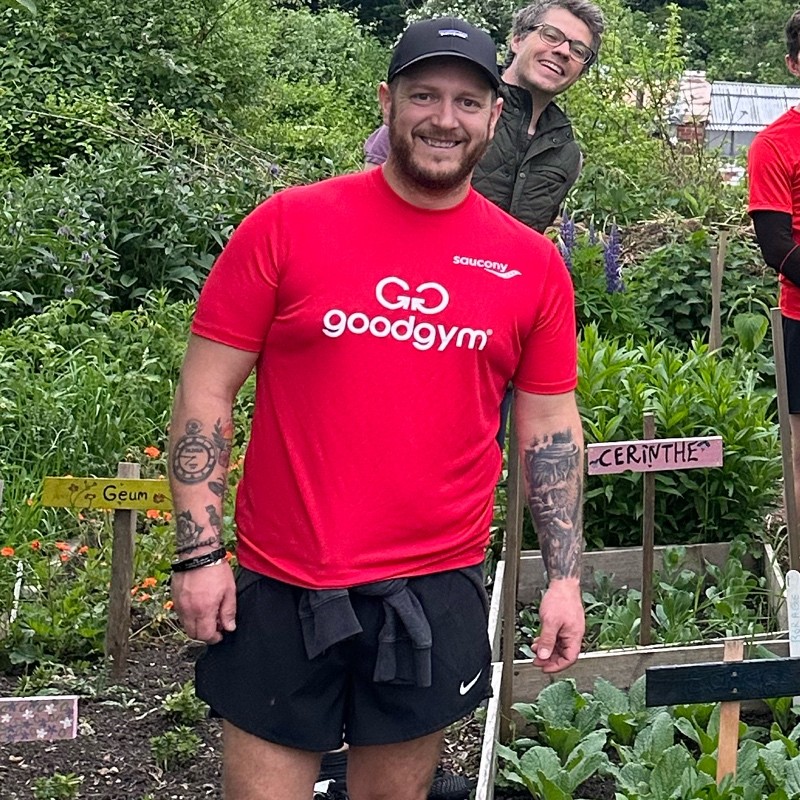
GoodGym began with a simple challenge: why are we lifting weights that do not need lifting, and running miles from A to B, when our communities and the environment are full of real tasks that need strength, energy and action? Our founder, Ivo, realised his run could do more than improve his fitness. He began running to help his community with tasks, giving his workout purpose and real impact. Others saw this and joined in running with him. Running became community action and exercise became an environmental impact...and that moment reframed what sport can be. Today, GoodGym uses movement to turn climate concern into visible, local change. Every week, people run, walk or cycle together to hands-on environmental projects in their own neighbourhoods. Logs become weights. Wheelbarrows become sleds. Digging, planting and habitat building become functional workouts. Streets become running routes. Parks, estates and waterways become shared training grounds and places of climate resilience. Participation is simple and flexible. Young people can sign up in just a few clicks and join regular local sessions without cost or long-term commitment. That accessibility removes barriers and builds habits. Sessions happen weekly so climate action becomes routine rather than reactive. GoodGym harnesses physical activity as an environmental mobilisation tool. Movement builds connection. Connection builds ownership. Ownership builds sustained action. By embedding environmental improvement into exercise, young adults improve the environment and all while improving their own mental and physical wellbeing. We are not asking young people to find extra time for the climate crisis. We are redesigning how they move, train and gather so climate action becomes part of everyday life.
Collaboration with young people and the community: In what ways does your initiative engage young people and community members closest to the problem? What role do they play in building the solution you deliver?
Young people are not simply participants in Movement for Change, they shape how it works. In January 2026, GoodGym ran focus groups with young adults at Paddington Youth Club to better understand their motivations and barriers to participation. Wellbeing was a moderate to top priority for 87% of respondents, and 83% prioritised social connection. In interviews, all participants explicitly described mental health as their primary reason for joining group activity. At the same time, fear of judgement was identified as a barrier by all participants. Many expressed strong resistance to performance culture, rigid commitment and anything that felt pressured. Movement for Change is designed directly in response to these insights. Sessions are low-pressure, beginner-friendly and actively welcoming. Leaders are visible and approachable. There is no expectation of pace, performance or prior experience. Young people join for wellbeing and connection and stay because they build friendships quickly and experience active welcoming from leaders, both identified as universal retention factors in our research. From there, leadership pathways open. Through training 100 young Green TaskForce Leaders, young adults move from attendee to organiser. They shape where sessions take place, influence activities based on local need, and create the welcoming culture they themselves value. We are also recruiting an 18–25 Partnerships and Activation Coordinator to strengthen peer-led outreach and deepen collaboration with youth organisations. This ensures the initiative remains rooted in lived experience and neighbourhood context. Young people are not only participating in this project; they are shaping it, leading it, and sustaining it.
Potential for/Evidence of Impact: How do you imagine your initiative will make a difference in raising climate awareness, shifting behaviors, or reducing environmental impact or harm? If you have already implemented it, what difference have you made so far? What is the impact your initiative has had¡, and/or what impact do you envision having in the future?
What if climate action felt less like protest and more like power? Movement for Change transforms climate worry into collective movement bringing young people together each week to train, build and restore the places they call home. Raising climate awareness Awareness grows through action. When young adults plant trees, restore community gardens or improve neglected estates in their own neighbourhoods, climate change shifts from an abstract global issue to something local, practical and solvable. Participants build a personal connection to places and spaces, increasing long-term environmental responsibility. Shifting behaviours Habit is our impact multiplier with sessions running weekly, creating routine. Participants develop environmental skills, adopt active travel, and grow confidence as local leaders. Crucially, 46.9% of participants report they do not take part in environmental activity outside of GoodGym meaning we are unlocking access for nearly half of those involved. Reducing environmental harm Our projects deliver measurable, place-based environmental gains. We plant trees and greenery that support carbon capture, create and restore habitats, remove invasive species, maintain waterways, and improve biodiversity in underused urban spaces. These practical interventions do more than enhance appearance, they cool overheated neighbourhoods, improve drainage and flood resilience, expand wildlife corridors, and strengthen local green infrastructure. Evidence of scale and future impact GoodGym is already delivering environmental sessions across London, working with hundreds of community partners. Through Movement for Change we will scale this significantly, creating a new generation of climate-active young adults across London.
Innovation: What is different about your initiative compared to other solutions that are already out there? How is your approach original and innovative?
Movement for Change is innovative because it redesigns how climate action is accessed, organised and sustained. Environmental programmes are often site-based, time-limited or skills-specific whilst most sport programmes focus purely on the sport or fitness aspect. We fuse the two into a single, scalable system where everyday movement becomes climate action. Running, walking and cycling are not add-ons, they are the delivery mechanism. This shifts the structure of participation. Instead of asking young people to attend separate climate events, we embed environmental action into a weekly physical routine. Climate action becomes a habit. We also make sure our digital platform removes friction. Opportunities are visible, local and bookable in seconds, lowering the activation energy required to participate. No prior experience, specialist equipment or long-term commitment is needed. That combination of tech-enabled access and community-led delivery creates flexibility at scale. We also shift power. Young people are not simply volunteers; they can train as Green TaskForce Leaders, organising sessions themselves. This redistributes responsibility from professionals to communities, creating peer-led momentum and long-term sustainability. Our model has already been recognised. In 2025 GoodGym became the first charity to win the Sky Zero Footprint Award, outperforming major consumer brands. The campaign, delivering £700,000 in media value (not money) on 2026 will amplify this approach across London and create a rare opportunity to accelerate youth engagement at scale . Movement for Change does not invent a new sport or a new environmental project. It redesigns how both work together to turn everyday fitness into a scalable system for climate action and youth le
Roles and Responsibilities: Describe how responsibilities are shared among your team or partners.
GoodGym Central Team The Central Team provides strategic oversight, quality assurance and consistency across London. The Group Sessions Team oversees delivery, supports Area Activators (AAs) and Green TaskForce Leaders (TFs), and leads the recruitment, training and development of new TFs to ensure safe, inclusive and high-quality sessions. Within the Group Sessions Team sits the: 18–25 Partnerships and Activities Coordinator This dedicated role focuses on engaging young adults. They will build relationships with youth organisations, develop tailored opportunities for 18–25s, support young leaders into TaskForce roles, and ensure activities are shaped around young people’s needs and interests. The Marketing Team is responsible for attracting and onboarding new members and TaskForce Leaders, with a specific focus on engaging young people through digital campaigns, partnerships and targeted messaging. The Tech Team manages GoodGym’s digital platform, which lists local opportunities, enables simple sign-up, tracks participation and uses gamification (e.g. badges and milestones) to encourage sustained engagement. Area Activators (AAs) and TaskForce Leaders (TFs) AAs are local people that coordinate local delivery across boroughs, support partnerships and ensure sessions meet community needs. TaskForce Leaders also organise and lead sessions on the ground, onboard new participants, and act as local champions for youth-led environmental action. Volunteers/Participants Volunteers are central to delivery. Volunteers participate in sessions, develop skills, and progress into leadership roles, ensuring the programme remains peer-led and community-driven. Community Partners Local authorities, community groups, Friends of Parks groups, charities and managers of green and blue spaces provide sites, local knowledge and tasks. These partners help identify priorities, co-design activities and ensure environmental improvements are relevant and sustainable within each neighbourhood. We have hundreds of partners across 26 London boroughs.
Viability and Scalability: How are you setting your organization up for success, and what is your plan to ensure operational sustainability of your solution and its impact? What are your ideas for scaling your initiative to the next level?
Movement for Change is built on GoodGym’s established, city-wide operating model, which already supports regular group sessions, volunteer leadership and local partnerships across London's boroughs. This existing infrastructure provides a strong foundation for delivery, quality control and risk management, ensuring the initiative is operationally viable from day one. Operational sustainability is driven by a peer-led delivery model. By training 100 young Green TaskForce Leaders, responsibility for organising and leading sessions is embedded within communities rather than relying solely on paid staff. This approach reduces long-term delivery costs, builds local capacity and enables activity to continue beyond the funding period. Ongoing support from GoodGym’s Group Sessions Team, alongside marketing and technology functions, ensures consistency, volunteer retention and efficient coordination. Furthermore, the programme is designed to scale through replication rather than expansion of overheads. Sessions use existing public spaces and no-cost activities, making them easy to adapt to new locations. Additionally, our digital platform enables simple onboarding, participation tracking and communication, allowing growth without proportional increases in staffing.
Upcoming Milestones: Please provide an overview of the milestones that are required for your initiative to come to fruition/ to grow.
Quarter 1 Deliver 300 environmental volunteering sessions Engage 250 young adults Train 20 Green TaskForce Leaders Quarter 2 Expand delivery into additional neighbourhoods and green/blue spaces Launch targeted youth recruitment campaigns Deliver 450 sessions Engage 400 more young adults Train an additional 25 Green TaskForce Leaders (45 total) Quarter 3 Deliver the first flagship youth climate action event Deliver 600 sessions Engage 500 more young adults Train an additional 25 Green TaskForce Leaders (70 total) Quarter 4 Deliver the second flagship youth climate action event Deliver 650 sessions Engage 600 more young adults Train an additional 30 Green TaskForce Leaders (100 total) End of Year Outcomes 2,000 environmental volunteering sessions delivered 1,750 young adults engaged (18-25) 100 Green TaskForce Leaders trained (18-25)