Country of Residence
Nigeria
Project title
PACE Network: From Community Problems to Collective Action
Project Summary: Describe your project in one sentence
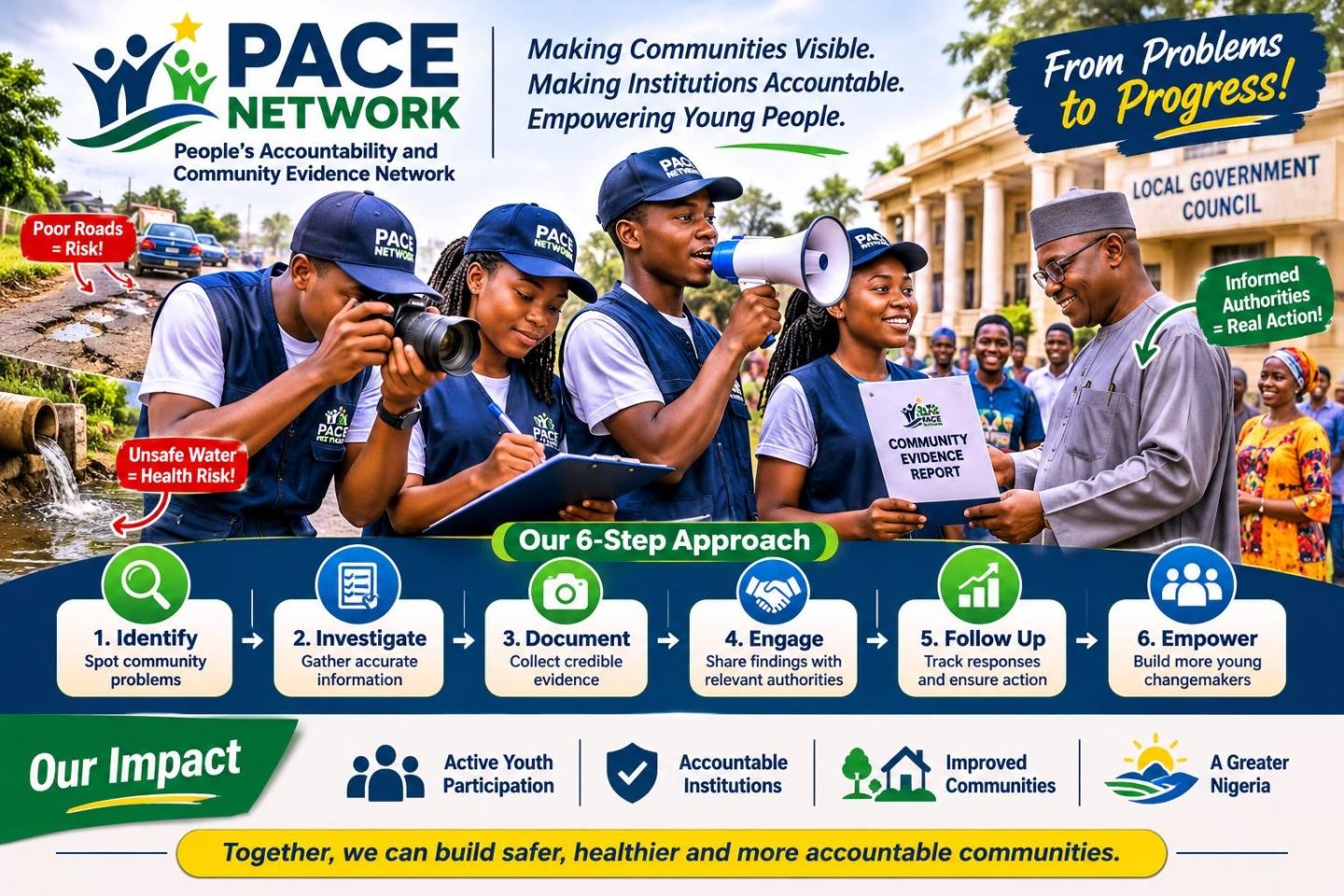
PACE Network introduces a structured approach to community accountability by combining youth leadership, evidence-based reporting, institutional recognition and continuous follow-up. Unlike conventional community awareness campaigns, which often stop at sensitisation, volunteering or reporting problems on social media, PACE Network seeks to establish a system through which trained young people become recognised and accountable Community Evidence Fellows.
Website URL(s) or social media handles.
Project Category
My project is a brand new / emerging idea
Project Stage
Pilot-Stage (We’ve tried an activity or two)
Founding Story: What was the spark that led you to start your project? What was the "Aha!" moment that led you to get started and see the potential for this to succeed?
PACE Network was born out of a personal experience that changed how I understood community problems and the responsibility of citizens in addressing them. On one occasion, while returning home from an event in my neighbourhood, I nearly got involved in a serious accident because of the deplorable condition of the road. What initially appeared to be an ordinary journey suddenly became a frightening experience. Beyond the immediate fear, I found myself asking a difficult question: How many people must experience preventable accidents before something is done about the roads they use every day? That experience made me look more critically at other challenges within my community. I became particularly concerned about the availability of clean and healthy water, as some residents rely on water sources whose safety is questionable. I began wondering whether the relevant authorities were fully aware of the realities people were experiencing. Even where authorities were informed, who was ensuring that these concerns received attention and that promised interventions were followed through? That was my defining moment. I realised that communities needed more than occasional complaints, social media campaigns or temporary expressions of concern. They needed an organised system through which problems could be identified, investigated, documented, communicated to authorities.
The Problem: What problem are you helping to solve? Why does it matter to you and your community?
Many Nigerian communities face challenges such as poor roads, unsafe water, inadequate sanitation and neglected public infrastructure. Although residents experience these problems daily, there is often no organised process for documenting them, communicating them to relevant authorities and following up on possible solutions. Complaints may remain informal, lack credible evidence or receive little attention. This gap between community problems and institutional response can leave residents frustrated and exposed to preventable dangers. My concern became personal when I nearly had an accident returning from an event because of a poorly maintained road. It made me reflect on how many people face similar risks and whether their concerns are effectively reaching the institutions responsible for addressing them. I am also concerned that young people, despite being directly affected by these challenges, often lack structured opportunities to participate in governance and community development. As a Sociology student, I believe meaningful development requires active citizen participation, effective communication and accountability. Through PACE Network, I want to help bridge this gap by equipping young people to identify community challenges, gather credible evidence, engage relevant institutions and follow up on responses. My goal is to build communities where residents are heard.
Your Solution: How are you solving this problem? Share your specific solution.
PACE Network will address this problem by training young people as Community Evidence Fellows (CEFs). These fellows will work with residents to identify pressing community challenges, investigate them, collect credible evidence and document their findings. They will then present these reports to the relevant authorities and community stakeholders through appropriate channels. The process will not end with submitting reports. Fellows will follow up on reported issues, document institutional responses and track progress through a Community Accountability Tracker. They will also remain accountable for the accuracy and ethical handling of their findings. Through this approach, PACE Network will create a structured connection between communities, young people and institutions, turning civic participation into practical action. Additionally, PACE Network will provide practical civic education and mentorship to help young people understand community participation, responsible advocacy and institutional engagement. Through this approach, we hope to build a network of informed young people who can work collectively with communities to promote lasting solutions and accountability. Our long-term goal is to establish a network of responsible young people across communities who can turn local concerns into credible evidence, constructive engagement and sustained accountability. We want to move beyond simply raising awareness to creating a process that encourages action and measurable progress.
Impact: How has your project created impact / made a difference so far? Or, if at an early stage, what will impact look like?
PACE Network is currently at the development stage, and we are working towards establishing a structured approach to youth-led community accountability. Although we have not yet launched our pilot or recorded beneficiaries, our initial target is to train 20–30 young people as Community Evidence Fellows, document at least 10 community challenges and engage relevant institutions to seek responses and action. We hope to make a difference by giving young people practical civic skills, helping communities communicate their concerns with credible evidence and encouraging institutions to become more responsive. We will measure our impact through the number of fellows trained, issues documented, reports submitted, institutional responses received and problems addressed. Ultimately, success will mean more informed young people, more engaged communities and stronger accountability between citizens and institutions. We also hope to strengthen the relationship between communities and public institutions. By presenting properly documented concerns and following up on responses, PACE Network will encourage more consistent communication and greater institutional responsiveness.
Your Innovation: What is different about your project compared to other programs or solutions already out there? How is your project new or innovative?
PACE Network is different because it goes beyond simply raising awareness about community problems. While many initiatives focus on advocacy, sensitisation and public complaints, PACE introduces a structured process that moves from identifying a problem to investigating, documenting, reporting and following up on possible solutions. Another unique aspect is our decision to make young people the drivers of this process through the Community Evidence Fellows (CEFs). Rather than limiting youth participation to volunteering or awareness campaigns, we equip them with practical skills in community research, evidence gathering, responsible advocacy and institutional engagement. PACE also introduces a Community Accountability Tracker (CAT) to monitor documented challenges, reports submitted, institutions contacted, responses received and progress made. This creates a record that helps prevent community concerns from being forgotten after they have been reported. Most importantly, our approach promotes accountability in both directions. Fellows must uphold ethical standards and ensure their findings are accurate, while institutions are encouraged to respond to documented concerns. By combining youth leadership, community evidence, technology-supported tracking and sustained engagement, PACE seeks to create a more organised and practical approach to civic participation and community development. PACE Network also stands out through its emphasis on continuity and community ownership. Instead of treating community engagement as a one-time activity, we want to establish local teams of Community Evidence Fellows who maintain relationships with residents, monitor recurring challenges and follow up on unresolved concerns. This allows communities to remain actively involved.
How many people are on your team?
43
Your team: What role(s) do your team members play? How do you share leadership with them?
PACE Network is currently being developed under my leadership, and I am presently the sole person coordinating the initiative. I am responsible for developing its vision, designing its operational structure and building the foundation for its implementation. As the project grows, I intend to bring together young people with different skills and interests to support its activities. I hope to build a team covering community research and evidence gathering, institutional engagement, training.
What’s Next: What are the next steps you plan to take to grow or strengthen your project over the next year? If your project is still in the idea stage, describe the steps you will take over the next three months to launch or begin developing it.
Over the next three months, my first priority is to establish a strong foundation for PACE Network. I plan to identify a suitable pilot community, engage residents and community leaders, and recruit an initial group of 20–30 young people as Community Evidence Fellows. I will also develop a training framework to equip them with skills in community research, evidence documentation, ethical reporting and institutional engagement. I intend to establish partnerships with youth associations, educational institutions and community development associations to strengthen the initiative. We will develop a code of conduct, verification standards and the Community Accountability Tracker to guide our activities and monitor progress. Following the initial training, we plan to conduct community assessments, identify pressing challenges and submit documented reports to relevant institutions. We will monitor responses, evaluate the effectiveness of our approach and identify areas for improvement. Ultimately, my goal is to build a sustainable model that can be replicated in other communities across Nigeria, creating more opportunities for young people to participate in governance and contribute to meaningful community development.
How do you encourage other people to join your project or learn about the problem you’re working on? If you have a new idea, tell us how you will do this in the future.
I believe people become changemakers when they realise that they have the capacity to influence the conditions around them. Through PACE Network, I intend to mobilise young people by connecting civic participation to problems they encounter in their everyday lives. Rather than relying solely on awareness campaigns, I want to give them practical responsibilities and opportunities to contribute to solutions. We will recruit through educational institutions, youth associations, community development associations and existing youth networks. Interested young people will receive training and mentorship before becoming Community Evidence Fellows. They will work in teams, investigate local challenges, document findings and engage relevant institutions. I also intend to use community meetings, storytelling, digital platforms and public presentations of documented findings to encourage wider participation. An important part of our approach is peer-to-peer mobilisation. Trained fellows will be encouraged to mentor others and establish additional community action teams. PACE Network is currently at the development stage, and I am working towards building its initial team and engaging its first cohort of young people.
