Age
16
Country of Residence
Nigeria
Founding Story: What was the spark that led you to start your project? What was the "Aha!" moment that led you to get started and see the potential for this to succeed?
The idea behind VELORA came from a question I kept returning to: what happens when young people have knowledge and ideas, but few opportunities to put them into practice? I noticed a gap between learning and real-world application. Students spend years gaining knowledge, yet often have limited opportunities to work on practical problems, collaborate, showcase their abilities or connect what they learn to community and industry needs. I realised the challenge was not a lack of talent, but a lack of accessible spaces where young people could explore ideas, test their abilities and develop useful solutions. That was my “aha” moment. I imagined a platform where learning could extend beyond textbooks and classrooms: a place where students could take part in real-world challenges, work with others and demonstrate what they can do through practical projects. I wanted schools, industries and NGOs involved too, bringing people together around shared challenges and opportunities for collaboration. Accessibility mattered, which is why I envisioned VELORA as an offline-first platform. That vision became VELORA, built on a simple belief: young people should not only learn, but have meaningful opportunities to apply their knowledge, showcase their abilities and turn ideas into solutions.
How do you encourage other people to join your project or learn about the problem you’re working on? If you have a new idea, tell us how you will do this in the future.
As VELORA is still at an early development stage, my focus so far has been on developing the idea, communicating its purpose and identifying the people and organisations who could contribute to its growth. I am building the project around a problem that affects students, schools and communities, and I want more people to recognise the importance of practical learning and giving young people opportunities to apply their skills. My plan is to engage students and schools by introducing them to VELORA's vision and showing how real-world challenges can make learning more practical. I also intend to reach out to NGOs and industries, encouraging them to contribute challenges, resources and opportunities that students can work on. Through school engagements, social media, community networks and direct outreach, I hope to create awareness about the gap between theoretical education and practical experience. I want students to see themselves not just as learners but as people capable of developing solutions. As the platform develops, I hope to build a community of students, educators, organisations and innovators who actively participate, share ideas and collaborate. My goal is to make VELORA a collective effort where everyone has a role in creating more practical and accessible learning opportunities.
How many people are on your team?
1
Impact: How has your project created impact / made a difference so far? Or, if at an early stage, what will impact look like?
VELORA is currently at an early development stage, so its impact is still being built. So far, I have worked on developing the concept, designing its approach and creating an initial prototype to demonstrate how the platform will work. Although we are yet to reach students and partner organisations at scale, the impact I envision is significant. I want VELORA to give students access to practical learning opportunities, real-world challenges and collaboration that may otherwise be unavailable to them. Through partnerships with schools, industries and NGOs, we aim to help students develop practical skills, apply their knowledge and create solutions to problems around them. Our intended impact goes beyond the number of users. It includes the number of students participating in challenges, projects completed, solutions developed, schools and organisations engaged, and opportunities created for young people. Starting in Nigeria, I hope to build a platform that makes practical learning more accessible, particularly for students with limited resources and exposure. In the long term, I envision expanding across West Africa, creating a wider network where young people can learn, collaborate and demonstrate their abilities. For me, success will mean seeing students move from simply acquiring knowledge to confidently applying it to solve real problems.
Project Category
My project is a brand new / emerging idea
Project Stage
Idea (We’re hoping to get started in the future)
Project Summary: Describe your project in one sentence
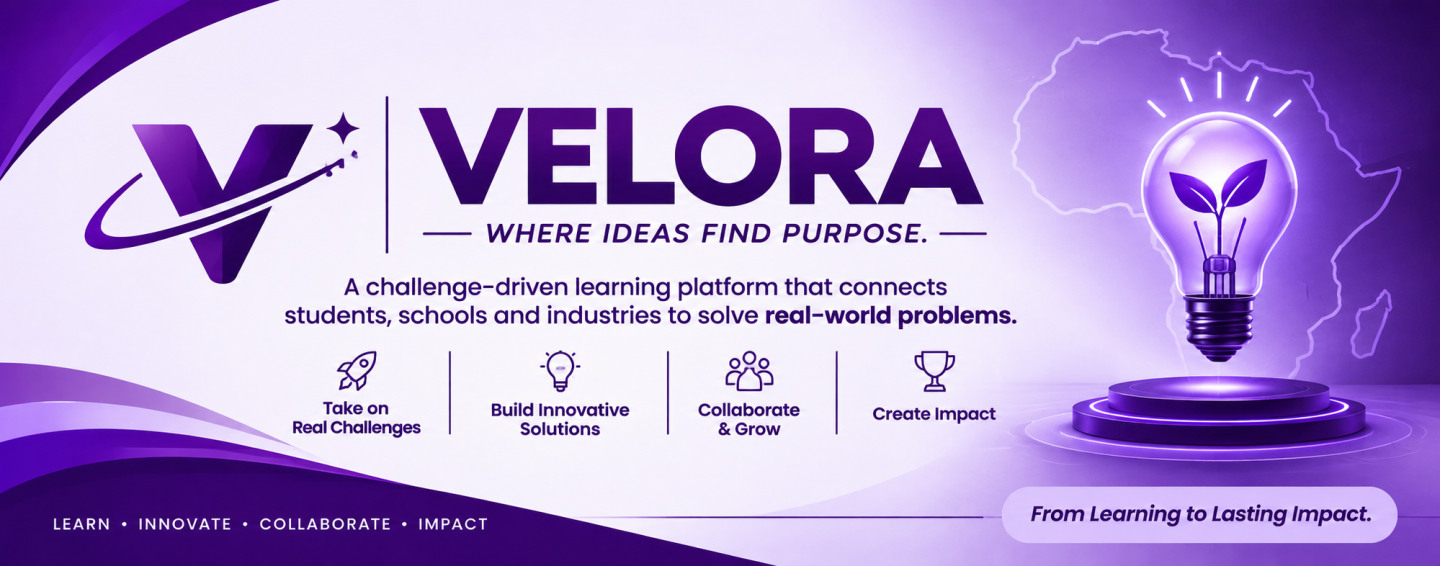
VELORA is an offline-first, challenge-led learning and collaboration platform that connects students, schools, industries and NGOs to solve real-world problems. Through practical challenges and collaborative projects, it helps young people apply their knowledge, develop relevant skills, showcase their abilities and turn ideas into solutions that create meaningful impact in their communities.It also creates pathways for collaboration, innovation and opportunities beyond the classroom.
Project title
VELORA – Ideas Into Impact
The Problem: What problem are you helping to solve? Why does it matter to you and your community?
In Nigeria, many students spend years acquiring theoretical knowledge but have limited opportunities to apply what they learn practically. Many possess technical skills, creative abilities and innovative ideas, yet lack access to practical resources, guidance and real-world challenges where they can develop and demonstrate these abilities. I see this affecting my community and Nigeria at large. Schools often lack the resources and opportunities needed to make learning more practical. As a result, students may leave school without sufficient experience applying their knowledge to real-life problems. This creates a gap between education and the skills needed by industries and communities, leaving much of our young people's potential untapped. This matters to me because I believe Nigerian youth have enormous potential, but they need opportunities and the right environment to develop it. Through VELORA, I aim to connect students and schools with industries and NGOs, creating opportunities for practical learning, collaboration and problem-solving. Students can work on real challenges, apply their skills, develop solutions and demonstrate what they can do. My goal is to make learning more practical and accessible while helping young Nigerians become active contributors to solving problems in their communities.
Website URL(s) or social media handles.
https://ask-velora-direct.lovable.app/
What’s Next: What are the next steps you plan to take to grow or strengthen your project over the next year? If your project is still in the idea stage, describe the steps you will take over the next three months to launch or begin developing it.
Over the next three months, my priority is to move VELORA from its current prototype stage towards a functional, testable app. I intend to begin by refining its design, developing its core features and strengthening its offline-first capabilities. Within the first few weeks, I hope to introduce the concept to students and selected schools, gather feedback and understand what users need most. This will help me improve the platform before its initial testing. I also plan to begin reaching out to schools, NGOs and industries to explore partnerships, source practical challenges and learning resources, and create opportunities for students to work on real-world problems. Another important step is identifying people with the technical and educational expertise needed to support VELORA's development as I work towards building a multidisciplinary team. By the end of the three months, I hope to have a stronger working prototype, initial user feedback, potential partnerships and a clear roadmap for launching VELORA and reaching its first group of students. My immediate focus is not rapid expansion, but building a functional solution, testing it with the people it is designed to serve and creating a strong foundation for sustainable growth.
Your Innovation: What is different about your project compared to other programs or solutions already out there? How is your project new or innovative?
What makes VELORA different is that it goes beyond providing educational content or teaching students new skills. It focuses on giving young people opportunities to apply what they learn, solve real-world problems and demonstrate their abilities through practical challenges. Many existing learning platforms focus primarily on delivering courses, lessons and information. While these are valuable, they do not always provide students with opportunities to test their knowledge in real situations or connect with organisations that need solutions. VELORA addresses this gap by bringing students, schools, industries and NGOs together on one platform. Through VELORA, industries and NGOs can introduce real challenges, while students can participate, collaborate, develop ideas and create practical solutions. Schools can use these opportunities to make learning more engaging and connect classroom knowledge with practical experiences. This creates a relationship between education and the actual needs of communities and industries. Another important feature is our offline-first approach. Recognising that unreliable internet access limits participation in digital learning, VELORA is being designed with accessibility in mind so that connectivity challenges do not automatically exclude students. Our innovation is not simply introducing another way to learn, but creating a system where learning, collaboration, practical experience and real-world problem-solving work together. We want to move young people from being passive recipients of information to active creators of solutions, while giving organisations access to fresh ideas and emerging talent.
Your Solution: How are you solving this problem? Share your specific solution.
VELORA is an offline-first digital learning and collaboration app designed to connect students, schools, industries and NGOs through practical learning, real-world challenges and problem-solving. The app works by providing a platform where industries and NGOs can present challenges based on real problems within their communities and sectors. Students can access these challenges, work individually or in teams, apply their knowledge, develop new skills and create practical solutions. Rather than learning only through theory, they get opportunities to learn by doing, explore ideas and demonstrate their abilities through actual projects. Schools can use VELORA to connect classroom learning with practical experiences, giving students opportunities to work on challenges beyond their regular lessons. Industries and NGOs can engage with young people, share relevant challenges, contribute resources and discover innovative ideas and potential talent. VELORA also prioritises accessibility through its offline-first approach, recognising that inconsistent internet access should not prevent students from participating in meaningful learning experiences. Our approach is built around bringing these different groups together rather than treating education, practical experience and industry needs as separate things. By connecting them through shared challenges and collaboration, VELORA helps students turn knowledge into skills, skills into solutions and ideas into opportunities. Ultimately, we want to create an ecosystem where young people are not just taught what to know, but are given opportunities to demonstrate what they can do and use their abilities to solve problems in their communities and beyond.
Your team: What role(s) do your team members play? How do you share leadership with them?
VELORA is currently led by me as its founder, and I oversee the project's vision, development, planning and strategic direction. At this stage, I work independently, making key decisions and driving the development of the idea. As VELORA grows, I intend to build a multidisciplinary team with individuals who can contribute to different areas, including software development, product design, partnerships, education and community engagement. I want to create a team where leadership is shared .
